Review: Funny Sitting Brown Bear ITH Keyfob Design
As a designer who has spent countless hours staring at digitizing software and even more time hunched over an embroidery machine, I have learned to look past the cute preview images. What matters is how a machine embroidery design behaves under the needle. Does it pull? Does it register correctly? Will the customer actually want to carry it around on their keys? Recently, I put the Funny Sitting Brown Bear ITH Keyfob through its paces for a small batch of holiday gifts, and here is my honest assessment of its performance in a real-world studio setting.
First Impressions and Visual Personality
The first thing that strikes you about this Wild Animals themed piece is its approachable charm. It is not trying to be hyper-realistic; instead, it leans into a playful, cartoonish aesthetic that reads well even at a small scale. The "sitting" pose is compact, which is crucial for key fobs where space is limited. When I loaded the embroidery file into my software to inspect the stitch path, I appreciated the logical flow. The layout feels balanced, avoiding excessive jumps that can lead to thread nests on the back of the project.
The mood is lighthearted and whimsical. This is not a serious corporate logo or a intricate heritage crest. It is a design meant to evoke a smile. For Etsy sellers and craft business owners, this emotional connection is vital. A key fob is an accessory people interact with daily. If the design makes them chuckle every time they unlock their car, you have created a loyal customer. The visual personality fits perfectly within the current trend of cozy, nature-inspired motifs that are dominating the handmade market.
Versatility in Real-World Applications
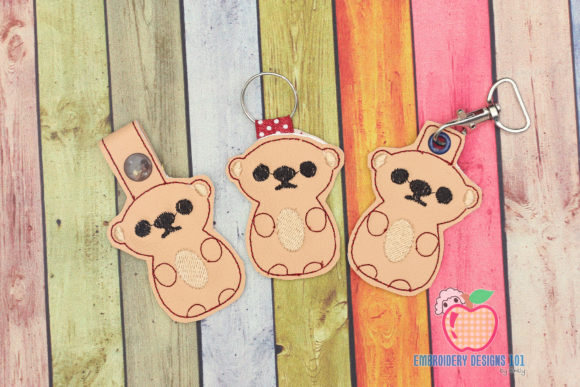
While this is marketed specifically as an In-The-Hoop (ITH) key fob, its utility extends further if you understand how to adapt it. The product description notes that it includes three versions: Snap Tab, Eyelet, and Ribbon. This versatility is a significant advantage for a small shop product line. During my test run, I focused on the Snap Tab version for a set of custom gifts for a local hiking group. The 4x4 hoop compatibility means it is accessible to almost every home embroiderer, from those with single-needle domestic machines to multi-needle commercial setups.
Beyond key fobs, consider how this bear could function as an embroidered patch if stitched out on stable fabric and cut away. It would work beautifully on a canvas tote bag design for a library or bookstore promotion. Imagine this bear peeking out from the corner of a heavy-duty canvas bag. It adds character without overwhelming the surface. Similarly, for baby embroidery projects, the soft, rounded lines of the bear make it safe and appealing for nursery decor, such as a small accent on a diaper bag or a personalized blanket tag, provided you use child-safe materials and secure all threads properly.
For custom apparel, this design is too small for a central chest placement on an adult sweatshirt but would be perfect for a cuff detail or a pocket accent on a flannel shirt. The compact nature of the bear allows it to serve as a subtle branding element for outdoor shops or nature guides. When creating printable mockup assets for your online store, showing the bear on various textures—like denim, corduroy, or felt—can help customers visualize the final finished product better than a plain white background ever could.
Technical Performance and Stitch Quality
Let us talk about the nuts and bolts of stitching. Working with a 4x4 hoop requires precision. There is no room for error in hooping. I found that the stitch density of the Funny Sitting Brown Bear ITH Keyfob was well-calibrated for its size. It uses a mix of satin stitch for the outlines and defining features, and fill stitch for the body of the bear. This combination provides texture and dimension without making the key fob stiff or board-like.
However, attention must be paid to thread choice. Because the design is small, high-contrast thread colors are essential. I initially tried a monochromatic brown-on-brown scheme, and the details got lost. Switching to a lighter tan for the muzzle and a dark chocolate for the outline made the bear pop. If you are using this for commercial embroidery where speed is key, ensure your tension is perfectly balanced. Small designs magnify tension issues; loose top thread will look sloppy immediately.
The inclusion of the Eyelet and Ribbon options is thoughtful. The Eyelet version is particularly robust for key rings that take a beating. I tested the durability by attaching it to a heavy set of keys and tossing it in a bag for a week. The stitching held up remarkably well, with no sign of unraveling. This durability builds customer trust. When a buyer sees that a personalized gift can withstand daily wear, they are more likely to leave a positive review and return for future purchases.
Navigating Fabric and Hoop Constraints
Not every fabric is suitable for this type of project. Since this is an ITH design, you are essentially creating a 3D object. You need fabrics that have some body. Thin, slippery silks or highly stretchy jerseys are poor choices for the main structure of the key fob. They will shift during the stitching process, leading to misalignment. I recommend using medium-weight cotton, denim, canvas, or felt. These materials provide the necessary stability for the running stitch anchors and the denser fill areas.
If you are attempting to place this design on curved surfaces, such as a cap, proceed with caution. While the bear itself is flat, the ITH construction creates a tab that might not lay flush on a curved brim. For caps, it is better to stitch the bear as a flat applique or patch rather than using the ITH folding method. Also, be mindful of dark fabric backgrounds. If you are stitching on black or navy, you may need to add a layer of white stabilizer or use a lighter underlay to prevent the fabric color from showing through the lighter parts of the bear’s face.
Proper stabilizer selection is non-negotiable. For ITH projects, I prefer a cut-away stabilizer for the final structural integrity, especially if the key fob will be subjected to pulling and tugging. Tear-away might seem easier, but it can leave residue in the tight corners of the bear’s ears and paws, compromising the clean look of the embroidery project.
Designer Notes for Best Results
Before you commit to a large production run, always test the design on scrap fabric identical to your final material. Check the registration of the eyes and nose; these small details define the character’s expression. If the eyes are off by even a millimeter, the bear can look cross-eyed or distressed rather than funny. Use the zoom function on your machine or software to inspect these critical areas.
Consider the licensing terms carefully. The prompt mentions checking if you have the rights, so always confirm whether the digital embroidery file allows for commercial use of the finished items. Most designers allow you to sell the physical handmade product, but reselling the digital file itself is usually prohibited. Respecting these boundaries ensures a healthy ecosystem for all creative entrepreneurs and design assets creators.
Finally, think about your presentation. A well-stitched bear deserves good hardware. Use high-quality snap tabs or sturdy ribbons. The perceived value of your Holiday embroidery gift or boutique item is determined by the weakest link. Do not let a cheap plastic clip undermine the quality of your stitching. By paying attention to these details, the Funny Sitting Brown Bear ITH Keyfob becomes more than just a design; it becomes a signature piece for your brand, demonstrating professionalism and care in every stitch.